

A Global Atlas of Digital Dermatology to Map Innovation and Disparities
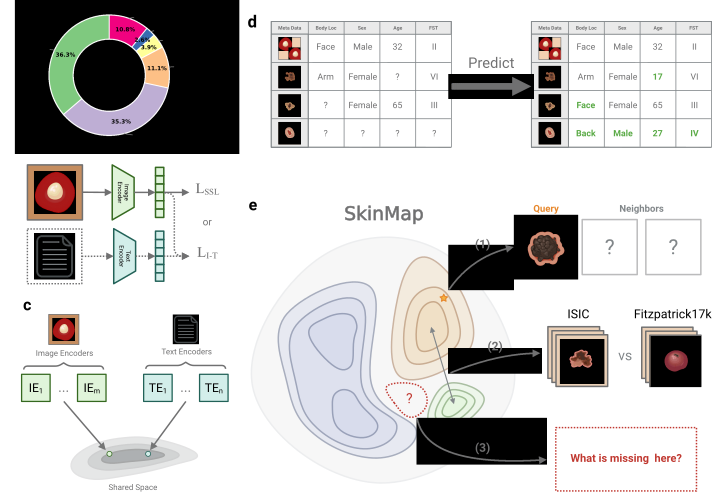
SkinMap is a dermatology image/text embedding model. It fuses 12 frozen teacher encoders (multi-modal and self-supervised models) through a trained projector into a single 1024-d shared image/text space, that can be used to infer missing metadata, solve downstream tasks, and get relational information about the samples.
Compute. This is the faithful full ensemble: 12 backbones load into memory at once and need roughly 16 GB of GPU VRAM. It runs on CPU but slowly.
Usage
from transformers import AutoModel

model = AutoModel.from_pretrained(
    "Digital-Dermatology/SkinMap",
    trust_remote_code=True,
    device="cuda",            # "cpu" also works
)

# 1) Encode an image into the 1024-d SkinMap space (L2-normalized)
img_emb = model.encode_image("lesion.jpg")            # np.ndarray, shape (1024,)

# 2) Encode a text query into the same space
txt_emb = model.encode_text("melanoma on the back")   # np.ndarray, shape (1024,)

# 3) Predict clinical metadata from the image
meta = model.predict_meta("lesion.jpg")
# {'fitzpatrick': 3, 'fitzpatrick_grouped': '3-4', 'age': 42.1,
#  'gender': 'female', 'origin': ..., 'body_region': ..., ...}

import numpy as np
sim = float(np.dot(img_emb, txt_emb))                 # cosine in the shared space
encode_image accepts a file path, raw bytes, or a PIL.Image. encode_text
expands the query into clinical prompt templates and averages the results; pass
templates=["{}"] to encode the raw text as-is.
Metadata prediction
predict_meta applies bundled linear probes to the SkinMap embedding to estimate
Fitzpatrick skin type, age, sex, geographic origin, body region and more. By
default it uses global probes, which reproduce the demographic estimates
reported in the paper. If you know the imaging modality, pass it to switch the
Fitzpatrick prediction to a modality-specific probe (more accurate when the
modality is known); the other attributes stay global:
meta = model.predict_meta("lesion.jpg", modality="dermoscopy") # clinical | dermoscopy | TBP
predict_meta also accepts a precomputed 1024-d vector instead of an image, and a
subset via attributes=[...].
Nearest-neighbor search (optional)
If this repo was built with an atlas index bundled, you can retrieve neighbors directly:
indices, distances = model.search("lesion.jpg", k=10)
Without a bundled index, search() raises a clear error. Encoding still works.
What's inside
| Component | Role |
|---|---|
| 9 multi-modal teachers (CLIP & SigLIP; ViT-L/14 & ViT-B/32) | image + text features |
| 3 self-supervised teachers (DINO, iBOT, MAE; ViT-B/16) | dermatology image features |
Per-teacher whitening (whitening_stats.npz) |
decorrelate before fusion |
Trained projector (projector_model.pth) |
fuse to 1024-d image/text heads |
Metadata probes (probes/) |
linear probes for predict_meta |
Licensing
SkinMap is released under the Creative Commons Attribution-NonCommercial 4.0 International license, for research use only. Not a medical device. Not for clinical decision-making.
- Downloads last month
- 138